Hawks and other raptors are routinely observed performing maneuvers that far surpass the capabilities of modern flight systems. At UC Davis, researchers are studying the aerodynamic and physical characteristics that allow these birds to dive, change direction, and navigate obstacles with remarkable speed, precision, and control. To capture these rapid, complex movements, researchers rely on sub-millimeter motion capture technology, which allows them to digitize the biomechanics of raptor flight. Their findings could help advance drone technology while also improving raptor rehabilitation.
Officially opened in 2026, the Center for Animal Locomotion and Innovation (CALI) brings together two unlikely research groups: the UC Davis College of Engineering and the UC Davis Weill School of Veterinary Medicine's California Raptor Center. The idea for CALI grew out of a collaboration between Christina Harvey, assistant professor of mechanical and aerospace engineering, and Michelle Hawkins, professor at the School of Veterinary Medicine and director of the Raptor Center.

A grant from the U.S. Army Combat Capability Development Command Army Research Laboratory provided funding to build a research facility and equip it with nine Phantom high-speed cameras and an OptiTrack motion capture (mocap) system with 44 VersaX 120 cameras and 4 Prime Color cameras.
“What has always inspired me is that birds can do things that we can’t yet design aircraft to do,” Harvey said. “The goal of our research is to understand the physics-based principles of their maneuverability.”
Built for Agility
The CALI facility is roughly the length of a basketball court and includes studio lighting that simulates daylight conditions. The high-speed cameras, which are synced with the OptiTrack system, record 1,000 frames per second at 4K resolution from multiple angles. With that data, the researchers are creating complete 3D reconstructions of the birds.

OptiTrack is employed to track small reflective dots attached to the raptors’ wings, bodies, and tails, capturing flight motion data with sub-millimeter accuracy. The 12-megapixel VersaX 120 cameras provide the extreme resolution and high frame rates required to track minute marker movements across the large flight volume. Meanwhile, the Prime Color cameras provide fully synchronized, 1080p reference video, allowing researchers to visually verify the 3D data against pristine footage of the birds in motion.

“Birds are so complex—their feathers are flexible, they’re porous, and they can have very weird shapes,” Harvey explained. “There are 10,000 species of birds that have different shapes and sizes and goals they are working towards.”
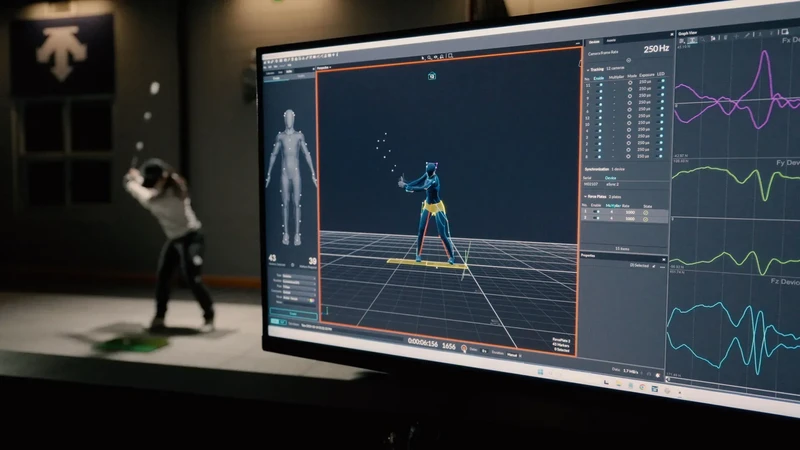
With so many dynamic factors influencing raptor flight, Harvey said the challenge becomes isolating the relevant aspects that would apply to aircraft design. To address this, she leads with hypothesis-driven research. “I characterize our lab as bio-informed,” she said. “We collect kinematic data from the birds and then decouple the variables one by one, using an engineering approach to identify each component with the biggest effect on flight behavior. OptiTrack’s Motive software allows us to seamlessly capture and process this complex kinematic data.”
As part of one study, Harvey plans to fly a peregrine falcon, a Harris's hawk, a merlin, and a goshawk. Reflective markers attached to the edges of the birds' tails will measure tail spread as they approach a perch. Additional markers will define the main body axis, and three markers down each side of their wings will capture wing angles.

“We are going to quantify the kinematics of the wings as the birds perch and land, giving us an explicit measure of each species’ response,” Harvey said. “As we build out the center, we hope to integrate wind gusts to test the reaction speed of each bird. And we want to build obstacle courses to evaluate specific characteristics one at a time.”
Another area of active research concerns wing morphology and how it influences the aerial agility of raptors. The researchers are particularly interested in how birds can adjust the shape of their wings to modify their aerodynamic performance—shifting between stable and unstable (more maneuverable) configurations as flight demands change.
Harvey believes that raptor morphing could play a role in informing future designs of aircraft or uncrewed aerial systems (UAS). “Birds have an amazing degree of freedom in their wings,” she said. “One of the questions we want to answer is what level of morphing would be needed to obtain the same type of functional trajectory.”
A New Tool for Raptor Rehabilitation
The research at CALI has implications beyond aircraft design. With the data they collect, the researchers hope to build a database that establishes metrics for healthy raptor flight.
Currently, decisions related to raptor rehabilitation rely largely on expert veterinary judgment and an understanding of how individual species survive in the wild. While those perspectives remain essential, the ability to compare the flight mechanics of rehabilitated birds against healthy flight patterns would provide veterinarians with a quantitative tool for evaluating recovery and supporting release decisions.
“Animal flight can vary significantly, so we want to build a large enough database to identify overarching patterns that are true for a species,” Harvey said.
The initiative demonstrates one of the ways that CALI brings together the expertise of aerospace engineers and veterinarians. “Rather than working in silos, we are creating a true transdisciplinary space,” Harvey said.

- Faiza Alvi, PhD Researcher - BIRD Lab
- Huanglun Adam Zhu, PhD Researcher - BIRD Lab
- Dr. Christina Harvey, Assistant Professor, BIRD Lab Director, CALI Director
- Dr. Alfonso Martinez-Carmena, Postdoctoral Scholar - BIRD Lab
- Alex Fillman, PhD Researcher - BIRD Lab
OptiTrack thanks Professor Christina Harvey and the Biologically Informed Research and Design (BIRD) Lab, West Coast Falconry, the Center for Animal Locomotion and Innovation, and the staff and volunteers of the California Raptor Center at the UC Davis School of Veterinary Medicine for welcoming us in and sharing their work. To learn more about the California Raptor Center or support its rehabilitation mission, visit crc.vetmed.ucdavis.edu.